
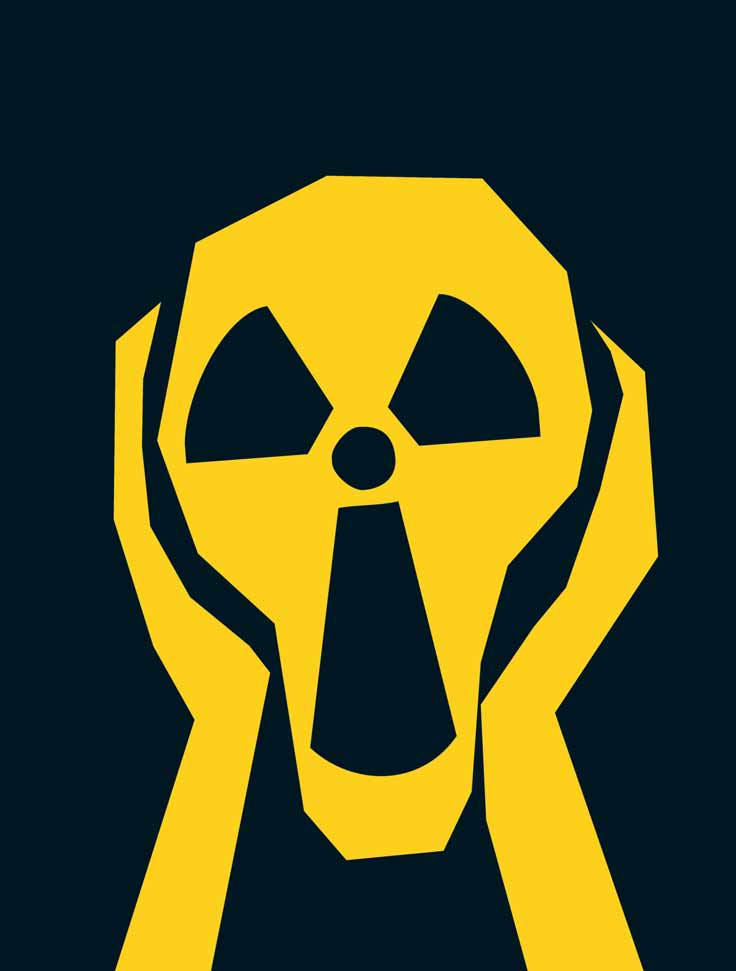
In the autumn of 2022, the United States picked up intelligence that Vladimir Putin was considering a nuclear strike in Ukraine. The Russian offensive was in serious trouble. Ukrainian troops had broken through the Russian lines near Kharkiv in the north-east, and now they were closing in on the Russian-held city of Kherson in the south. If the rout continued, the Central Intelligence Agency reportedly put the probability that Putin would order the use of tactical nuclear weapons at 50 per cent. For the “first time since the Cuban missile crisis”, Joe Biden told a private gathering of Democratic donors that October, “we have a direct threat of the use of a nuclear weapon”.
The Americans scrambled to persuade Putin to change course. The then national security adviser, Jake Sullivan, publicly warned that Russia would face “catastrophic consequences” if it went ahead. Bill Burns, the head of the CIA, flew to Ankara to convey the same message to his Russian counterpart. The US secretary of defence, Lloyd Austin, called Russia’s defence minister, Sergei Shoigu, twice. “We know you are contemplating the use of a tactical nuclear weapon in Ukraine,” Austin told Shoigu during one call, according to the American journalist Bob Woodward. “If you did this, all the restraints that we have been operating under in Ukraine would be reconsidered.” Shoigu responded that he did not “take kindly to being threatened”. “I am the leader of the most powerful military in the history of the world,” Austin replied. “I don’t make threats.”
Putin had invoked the spectre of Russia’s nuclear arsenal – the world’s largest – from the very first hours of the conflict. Announcing the start of his “special military operation” in the early hours of 24 February 2022, he warned any countries that might be “tempted to interfere” that they would face consequences “such as you have never seen in your entire history”. Three days later, in case the message was not sufficiently clear, he summoned his military leadership for a televised meeting where he complained about the “unfriendly” and “aggressive” actions of Western powers and ordered that Russia’s nuclear forces be placed on a “special regime of combat duty”. In September 2022, he made those threats even more explicit, citing the US atomic bombing of Hiroshima and Nagasaki in 1945 and remarking that they had “created a precedent”.
Regardless of whether Putin had any intention of following through on his warnings – the battlefield logic for a nuclear strike was always dubious – his repeated signalling thrust the danger of nuclear weapons back to the heart of international security in a manner that had not been seen since the height of the Cold War. The prospect of a cataclysmic nuclear exchange had largely receded from the public consciousness over the previous decades, as the days of classroom “duck and cover” drills gave way to a new era of arms control and the giddy promise of globalisation. But the underlying threat never went away, and Putin’s nuclear brinkmanship turned out to be only the most visible aspect of a dangerous new nuclear age.

“The crux of it is that we’re back in a world where major great power war is thinkable,” said Ankit Panda, a senior fellow in the nuclear programme at the Carnegie Endowment for International Peace and author of The New Nuclear Age: At the Precipice of Armageddon. “At the same time, the sinews of the old arms control and non-proliferation architecture are rapidly crumbling as new technologies add additional anxiety.” The cumulative effect, he explained, was a “sea change in the role and relevance of nuclear weapons”.
That architecture was born of near-cataclysm, as the Cuban missile crisis, which brought the US and the Soviet Union to the brink of nuclear war over 13 days in October 1962, transformed strategic arms control into an urgent priority for the two superpowers. Within months, they had established the first hotline between Washington and Moscow and signed the Partial Test Ban Treaty, banning above-ground nuclear tests. Those early agreements led to broader arms control efforts. The Salt (Strategic Arms Limitation Talks) accords followed in 1972 and 1979, which sought to limit the growth of the two nations’ strategic nuclear forces and ease the burden of an unsustainably costly arms race, although the second agreement was not ratified by the US following the Soviet invasion of Afghanistan.
Despite the intense rivalry that persisted throughout the Cold War, both sides continued to recognise the mutual value of strategic arms control. As Ronald Reagan and the newly appointed Soviet leader, Mikhail Gorbachev, encapsulated the new consensus during their first summit in Geneva in 1985: “A nuclear war cannot be won and must never be fought.” Instead of the 25 nuclear-armed nations that John F Kennedy had warned could materialise by the 1970s, the 20th century concluded with only eight nuclear powers. This included the five officially recognised nuclear weapons states under the Nuclear Non-Proliferation Treaty (NPT) – the US, UK, Russia, China and France – alongside India, Pakistan and Israel, which are widely understood to have nuclear weapons but not formally recognised as nuclear powers. North Korea conducted its first nuclear test in 2006, becoming the world’s ninth nuclear-armed state, although it, too, is not recognised as such under the NPT.
The end of the Cold War heralded what some scholars have described as the “golden era” of arms control. From the late 1980s to 2010, Moscow and Washington negotiated successive treaties and dismantled tens of thousands of nuclear weapons. The number of nuclear weapons worldwide fell from roughly 70,300 at the peak in 1986 – the great majority possessed by the US and the Soviet Union – to an estimated 12,321 at the start of this year, although the numbers are gradually increasing again. For a brief period it was possible to imagine, as Barack Obama declared during his celebrated speech in Prague in 2009, that humanity was moving towards a “world without nuclear weapons”. Even then, he acknowledged that the goal would not be reached quickly, perhaps not in his own lifetime.
That promise has now vanished. The last remaining nuclear arms control treaty between the US and Russia expired in February, with little prospect of a new deal to follow and strong incentives for both powers to resume building up their arsenals. Russia deployed tactical nuclear weapons to Belarus in 2023, the first time since the collapse of the Soviet Union that Moscow has stationed nuclear warheads outside the country. Putin also ordered tactical nuclear weapons drills in 2024 and updated Russia’s nuclear doctrine to broaden the circumstances under which nuclear weapons could be used.
At the same time, the rise to power of Donald Trump in the US, with his wrecking-ball approach to global politics, has exacerbated long-held doubts among allies about the durability of American security guarantees. The US policy of extended deterrence, which commits to defend allied nations from attack, including, if necessary, with nuclear weapons, was not an act of charity. Washington had long since concluded that its interests were better served by reinforcing deterrence and discouraging proliferation, rather than confronting the inherent dangers of a world bristling with an ever-increasing number of nuclear weapons. This included pressuring South Korea and Taiwan to abandon their nuclear programmes in the 1970s and 1980s.
Trump does not appear to share this worldview. Campaigning for re-election in 2024, he said he would encourage Russia to do “whatever the hell they want” to a Nato member he deemed to be spending insufficiently on defence. He has since embarked on a series of trade wars against long-standing allies, renewed his threats to withdraw the US from Nato, and threatened to annex Greenland and Canada. Nor are these fears likely to be allayed by Trump’s eventual departure from office in 2029. “America First” clearly resonates with a significant portion of the electorate, and the same forces that swept Trump to power could just as easily deliver a future president who is equally sceptical of the value of alliances.
The consequences are already visible. Poland has entered talks with France and other European allies on plans for “advanced nuclear deterrence” across the continent. “We are arming up together with our friends so that our enemies will never dare to attack us,” Donald Tusk, Poland’s prime minister, explained on X earlier this year. Friedrich Merz confirmed last week that German conventional forces will join French nuclear exercises for the first time in September. France has also announced that it will increase the size of its nuclear arsenal for the first time since 1992. Unlike the UK, which relies on American support for the maintenance of its Trident missiles, France has long taken pride in the fact that its nuclear forces are fully independent of the US. “We are currently experiencing a period of geopolitical upheaval fraught with risk,” declared the French president, Emmanuel Macron, while standing in front of a French nuclear submarine. “Whoever wants to be free must be feared.”
“Different sets of allies are in different places,” Panda told me. “Western and northern European allies have been the most incensed by the turn in American statecraft, which has been overtly adversarial. Meanwhile, a sense of ‘no plan B’ permeates conversations in eastern Europe and the Pacific, where threats from China and Russia are more proximal.” The common thread, he said, was a growing consensus on the need for “more strategic autonomy” as governments around the world hedge against “perceived American political unreliability”.
This does not mean we will necessarily see a sudden global dash for the bomb, but rather a growing number of states quietly exploring their options and monitoring the actions of rival regional powers. There was a brief flurry of concern about the prospect of a Saudi nuclear programme last week after the US energy secretary, Chris Wright, announced on 22 July that he had signed a “historic” agreement with Riyadh. The White House promised the deal would yield billions of dollars for American companies and adhere to the “highest standards” for nuclear non-proliferation. Non-proliferation experts did not agree, pointing out that without strict provisions in place for international inspections, such as the “gold standard” protocols outlined in a 2009 deal with the United Arab Emirates, Saudi Arabia could acquire the technical capacity to enrich its own uranium and, should the leadership decide it needed one, shorten the potential pathway to the bomb.
But within 24 hours, Trump had thrown the entire deal into doubt, insisting on Truth Social that there would be “no enrichment of material!” and that the agreement was now “totally subject” to Saudi Arabia joining the Abraham Accords, meaning that the kingdom would also have to agree to normalise relations with Israel. In the short term, Riyadh is likely motivated by a desire for nuclear power to meet surging electricity demands and enable the country to export more crude oil. But the crown prince, Mohammed bin Salman, has also made clear that the kingdom is closely watching Iran’s nuclear capabilities, and that if Tehran ever develops a nuclear weapon, his country will be forced to follow suit. “If they get one, we have to have one,” he told Fox News in 2023, “for security reasons and the balance of power in the Middle East.”
A similar cascade could unfold in East Asia. Victor Cha, a Korea expert at the Center for Strategic and International Studies think tank and a former senior official on the US National Security Council under George W Bush, warned last month that if South Korea decides to pursue its own nuclear weapons, it could trigger a “nuclear domino chain” across the region. The idea is gaining popularity, with polls showing that 76 per cent of South Koreans now support the country acquiring its own nuclear deterrent as it confronts the threat of a nuclear-armed North Korea alongside growing doubts about US reliability. Cha’s research found much lower support among the country’s national security elites, with only 34 per cent in favour, although half of those currently opposed said this would change if the US downgraded its security presence, for instance by withdrawing American troops from the country, as Trump has periodically threatened.
Yet the most profound shift in the new global nuclear order may turn out to be China’s rapidly increasing arsenal. Mao Zedong initially dismissed the US atomic bomb as a “paper tiger” in 1946, but that stance began to change after the Korean War (1950-53) and the First Taiwan Strait Crisis (1954-55), when American officials openly debated the use of tactical nuclear weapons against China. “If we are not to be bullied in the present-day world,” Mao told the CCP leadership in 1956, “we cannot do without the bomb.” China carried out its first nuclear test in 1964, but swiftly declared a “no first use” policy, meaning that it would only launch nuclear weapons in response to an attack, and limited itself to a relatively small arsenal, with just over 200 warheads, until the 2010s. (By comparison, the US and Russia currently have approximately 3,700 and 4,300 warheads respectively.)
That posture changed dramatically under Xi Jinping’s leadership as the People’s Liberation Army embarked on a concerted expansion of its nuclear arsenal, beginning around 2018-19. Satellite imagery in 2021 revealed hundreds of new missile silos materialising across the country as China more than doubled its stockpile of warheads, which is expected to exceed 1,000 by the end of the decade. At the same time, China has rejected arms control negotiations with the US and Russia while such a large disparity remains between their strategic arsenals.
Borrowing from physics, arms-control experts have called this the “three-body problem”. Whereas two bodies moving in space can achieve a relatively predictable orbit, as the two nuclear superpowers did during the Cold War, a third body introduces uncertainty and makes the whole system more unstable. The challenge now is not simply to resurrect the previous era of bilateral arms agreements, but to design a new system that can adapt to China’s rapid rise. Add in the prospect of an expanded European arsenal and the potential emergence of a new set of nuclear powers in East Asia and the Middle East, and the three-body problem morphs into an even more complicated equation.
Undoubtedly, there will be more nuclear jingoism to come. Putin seems to have no intention of abandoning a tactic that has repeatedly served to unnerve Western policymakers and complicate decisions over the provision of advanced weapons to Ukraine. Other leaders – including Xi, as he weighs China’s claim to Taiwan – can hardly have overlooked the coercive value of this approach. That, in turn, raises the question of whether the US can ultimately be relied upon to honour its security commitments. In 1961, Charles de Gaulle famously asked John F Kennedy whether America would really be prepared to trade New York for Paris. The question today is whether American allies and adversaries alike genuinely believe that President Trump, with his apparent disdain for so many of these alliances, would be inclined to risk San Francisco for Seoul, or Miami for Taipei.
De Gaulle remained unconvinced. Less well known is his exchange with Kennedy the next day as he returned to the question. “Since you say so, Mr President, I believe you. But still, can one be certain?” Six decades later, with a perilous new nuclear age taking shape, the danger is that a growing number of states conclude the only real certainty lies in possessing a nuclear deterrent of their own.
[Further reading: The global crises Andy Burnham cannot escape]
Content from our partners


Related
This article appears in the 29 Jul 2026 issue of the New Statesman, The new terror
Join the debate
Subscribe here to comment